EFC Design 1003 (Hough type): Notes & Illustrations
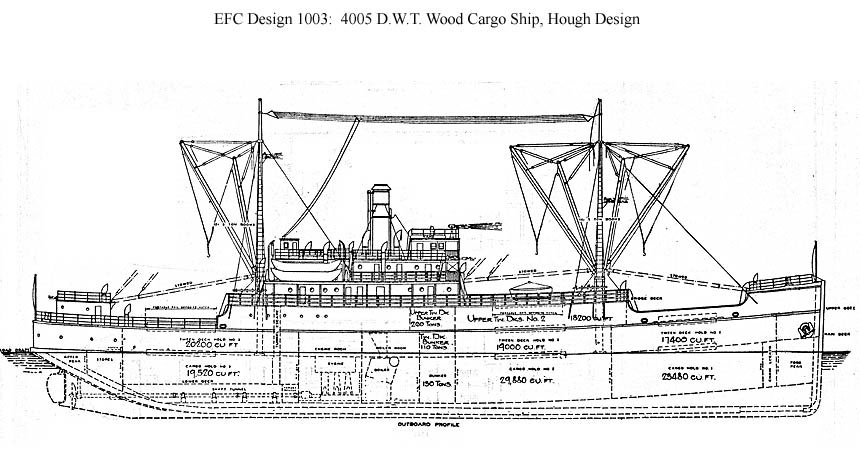
Click here for larger and more complete plans from the 1920 USSB ship register: Sheet 1, Sheet 2,
Click here for a similar plan from International Marine Engineering, September 1917: Sheet 1
Click on the photographs below to prompt larger views of the same images.
|
Notes: On 23 February 1917, as German U-boat warfare in the Atlantic intensified, a wealthy yachtsman-engineer, Frederic A. Eustis visited the president of the U.S. Shipping Board, William Denman, to propose responding to the U-boats by building wooden steamships. They could be mass produced and would not interfere with steel shipbuilding. The Shipping Board approved the idea on 20 March 1917 and President Wilson's cabinet followed on 31 March 1917. Within a few days Edward S. Hough, a naval architect already known to Denman, proposed a ship of his design that was about to be launched at Coos Bay, Oregon, Johanna Smith, as a model for a mass-produced 3500 deadweight ton wooden freighter. Johanna Smith was of relatively shallow draft for coastal use and had only a single deck, and she was given the necessary strength by a heavy centerline bulkhead running the length of the ship, thick wing bulkheads inboard of the sides, and several transverse bulkheads. On 11 April 1917 the vice chairman of the Shipping Board, Theodore Brent, visited Coos Bay, inspected the ship, and promised that Coos Bay would be awarded contracts for twelve vessels, eight to be built at Kruse & Banks and four at a new shipyard that became Coos Bay S.B. For the Shipping Board's ship Hough added an upper 'tween deck in the form of a long bridge island to provide space for more cargo or bunker coal, increasing her capacity to 4005 dwt. Between June and September 1917 six contracts for a total of 37 EFC Design 1003 Hough type steamers were awarded, five to shipyards in Oregon and one to a California yard. The design later fell out of favor and no more were ordered. Wealthy yachtsman were also the main advocates for the Navy's section patrols, in which large numbers of yachts and other small private vessels were enrolled, given SP numbers, and commissioned to defend the U.S. coast against submarines. (Special source: Louis A. Hough, A Fleet to be Forgotten, San Francisco, 2009.) Specifications: Design 1003 (Hough). Wood hull. Deadweight tons: 4005 designed, 3870 actual. Dimensions: 289.0' oa, 272.7 to 275.2' pp (varies by builder) x 46.1' ext, 45.4' mld x 28' depth mld, 23.25' draft load. Propulsion: 2 screws, 2 triple expansion engines, 2 EFC standard watertube boilers, 1400 IHP, 10 knots. Configuration: 2 decks, 3 holds, 6 hatches. |
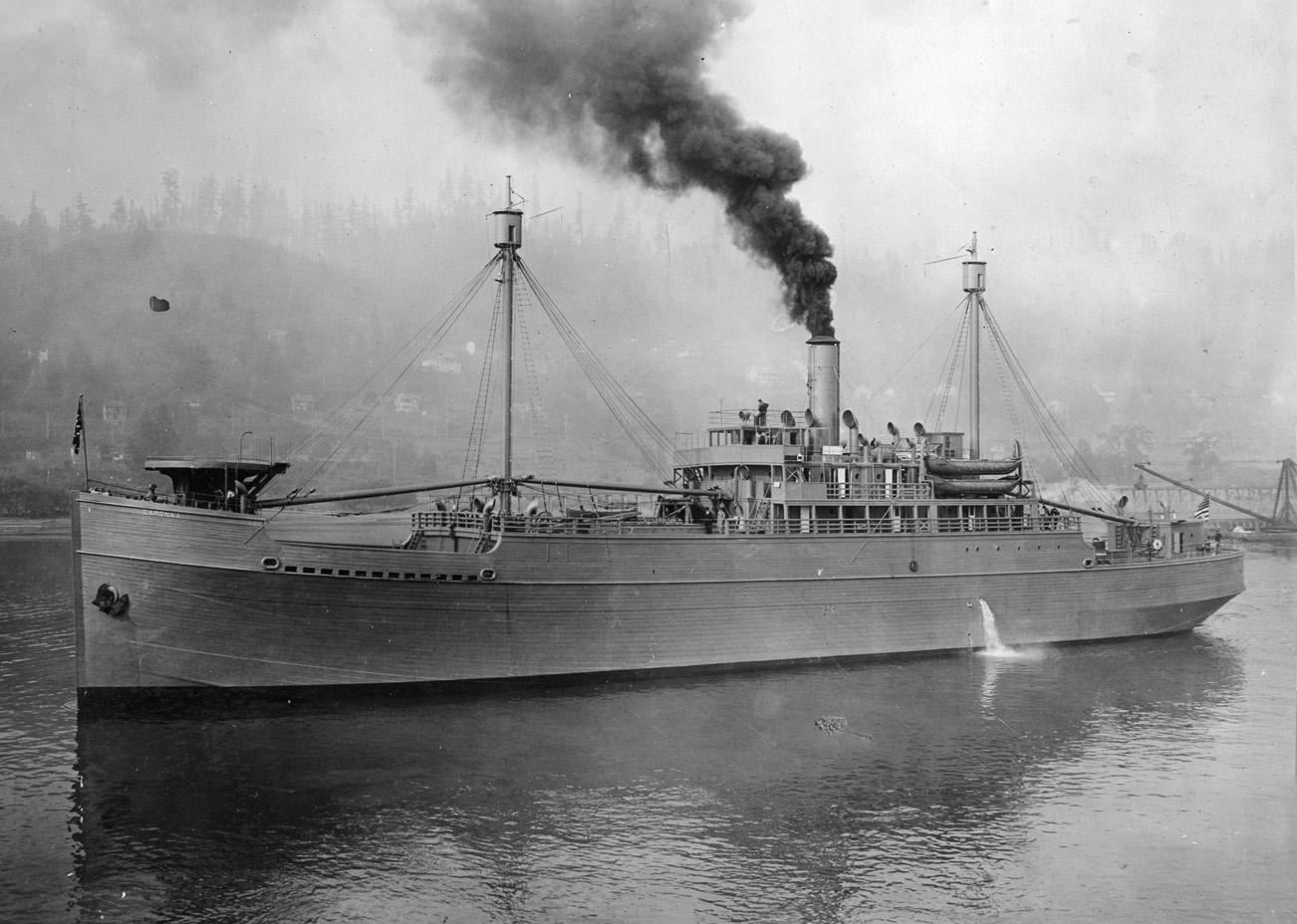
| S.S. Caponka (Design 1003, EFC Hull 259), the tenth of twelve Hough-type ships built by the Grant Smith-Porter Ship Co. of St. Johns (Portland), Ore., on trials on 10 September 1918. She achieved celebrity for being built in the record time of 49 days, a record surpassed five months later by Grays Harbor's Aberdeen. (U.S. National Archives, RG-32-M box 13) (Click photo to enlarge) |
|
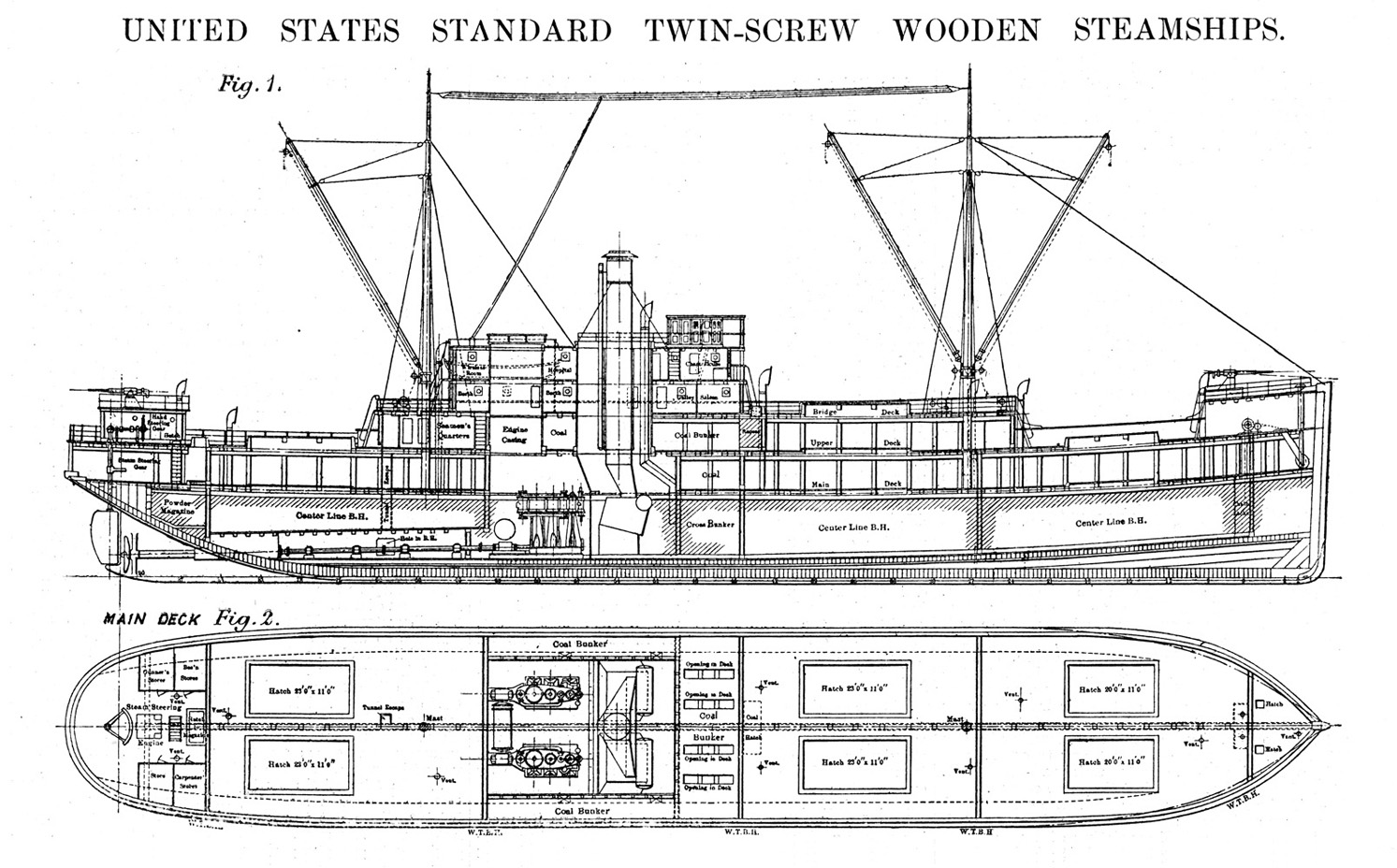
United States Standard Twin-Screw Wooden Steamships (Design 1003) A cutaway drawing, probably provided by the EFC, first published in New York's International Marine Engineering in September 1917 and reproduced in London's Engineering on 12 October 1917. Note in the overhead view the key longitudinal strength member of the hull, a centerline bulkhead (changed from steel to wood before construction) running the length of the ship that forced the use of port and starboard holds, hatches, engines, and screws. The unusually long bridge island amidships provided a second 'tween deck over the holds allowing the ship to carry additional cargo and coal. Photo No. None Source: London Engineering, 12 October 1917, page 381 |
 |
|
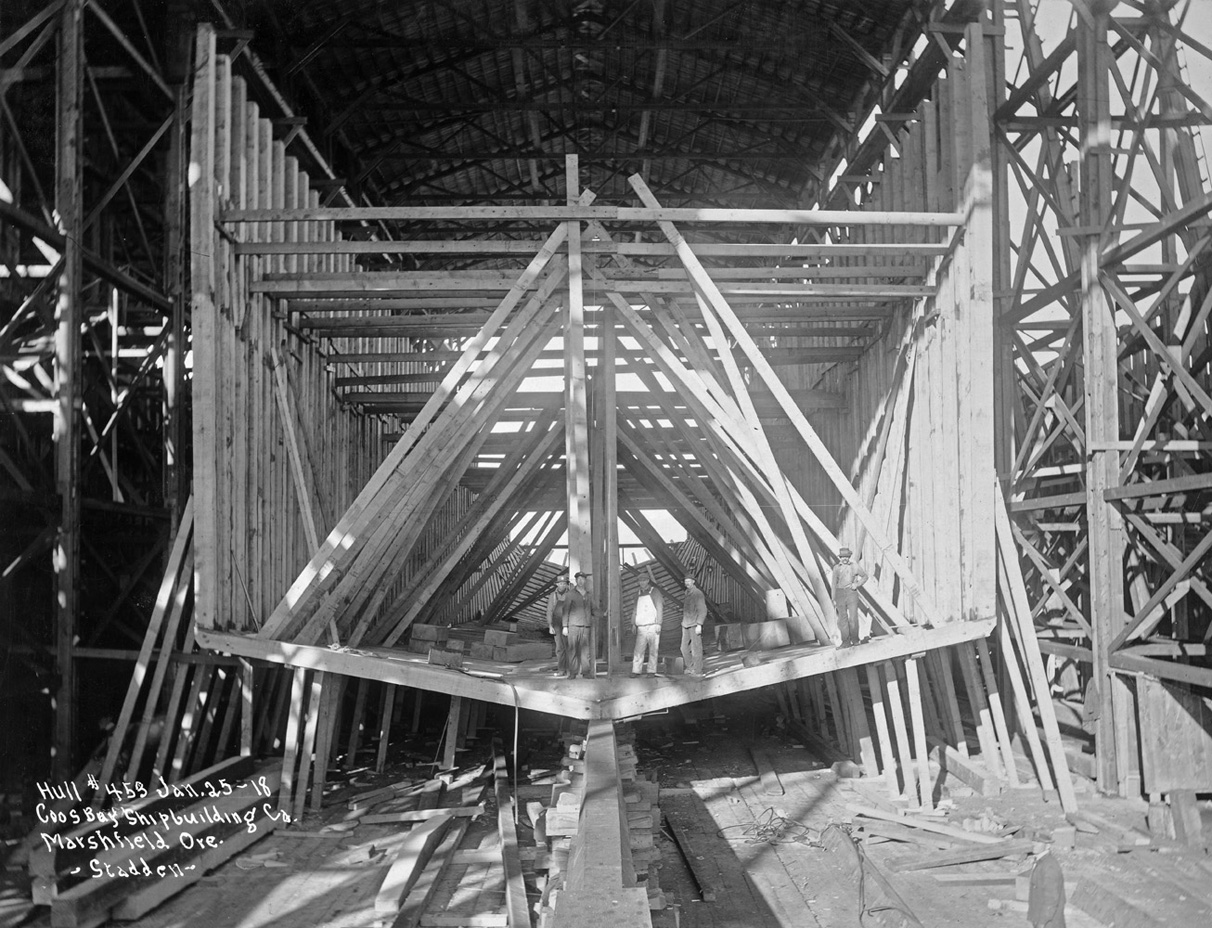
S.S. Cohasset (Design 1003, EFC Hull 453) In frame on the ways at the Coos Bay Shipbuilding Co.of Marshfield, Ore., on 25 Jan 1918, showing Hough's extensive use, except at the ends, of the straight timbers commonly produced at sawmills. The result was a ship with a V-shaped bottom, flat sides, and a sharp angle (chine) between them. Theodore E. Ferris, then the chief naval architect of the EFC and an advocate of the conventional round hull form with a flat bottom and curved bilge, called Hough's the "square bilge, straight timber type" but allowed that it was "better than expected." He had Hough add diagonal steel straps to increase the longitudinal strength of the hull. The steel strapping and centerline bulkhead were later changed to wood. Cohasset was renamed Marshfield five days after launching. Photo No. 165-WW-500D-005 Source: U.S. National Archives, RG-165-WW |
 |
|
S.S. Wanzu (Design 1003, Hull 440) On the ways at the Sommarstrom Shipbuilding Co. of Columbia City, Ore., on 8 December 1917, demonstrating why Hough's hull form was likened by some to a "drygoods box" and called by others a "scow type." Contracts for 40 Hough ships (Design 1003) were awarded between June and September 1917 but by the time the Hough yards were ready for follow-on contracts the Ferris type (Design 1001) had become the EFC's standard and the later contracts were for Design 1001 ships. Hough's design and the individual histories of many Design 1003 ships are described at depth in a book by Louis Hough (the designer's grandson), A Fleet To Be Forgotten: The Wooden Freighters of World War One (San Francisco Maritime Press, 2009). Photo No. 165-WW-503G-002 Source: U.S. National Archives, RG-165-WW |
 |
|
S.S. Wasco (Design 1003, Hull 250) At the Grant Smith-Porter Ship Co. of St. Johns (Portland), Ore., just before launching on 17 February 1918. The first of this yard's twelve Hough ships, she was one of four early Hough ships (also including North Bend completed with three-bladed propellers before a change to four-bladed screws recommended by Hough in January 1918 took effect. Hough's rudder, a cast steel box type, was too small, improperly proportioned, placed too high above the base line of the keel, and located behind flat stern lines that made it difficult for any rudder to function efficiently. The operational record is full of complaints about steering deficiencies in this class. Photo No. 165-WW-501C-002 Source: U.S. National Archives, RG-165-WW |
 |
|
S.S. Wankan (Design 1003, Hull 261) The last of the Hough ships built by the Grant Smith-Porter Ship Co. of St. Johns (Portland), Ore., being launched on 25 May 1918. This yard launched twelve of these ships in just over three months. Note the steel box type rudder. Wankan was renamed Holbrook before entering service. Photo No. 165-WW-503M-023 Source: U.S. National Archives, RG-165-WW |
 |
|
S.S. Astoria (Design 1003, Hull 659) The first of the ten Hough ships built by the McEachern Ship Co. of Astoria, Ore., fitting out afloat on 31 May 1918. She was finally accepted by the EFC Operations Department on 10 October 1918 but her machinery still needed a lot of work. On her first commercial voyage in November 1918 her captain reported that, among many other problems, "something is radically wrong with the rudder as she is very hard to keep on a course." Photo No. 165-WW-504A-001 Source: U.S. National Archives, RG-165-WW |
 |
|
S.S. North Bend (Design 1003, Hull 426) The first of the Hough ships to be laid down and the first to enter service, shown in brand new condition in a photo received on 8 June 1918. Built by the Kruse & Banks Shipbuilding Co. of North Bend (Coos Bay), Ore., she was laid down on 28 July 1917 and delivered to the EFC on 24 May 1918 and to her managing operator, Matson, a day later. She left San Francisco with a cargo of coal on 3 June 1918. Photo No. 165-WW-504A-001 Source: U.S. National Archives, RG-165-WW |
 |
|
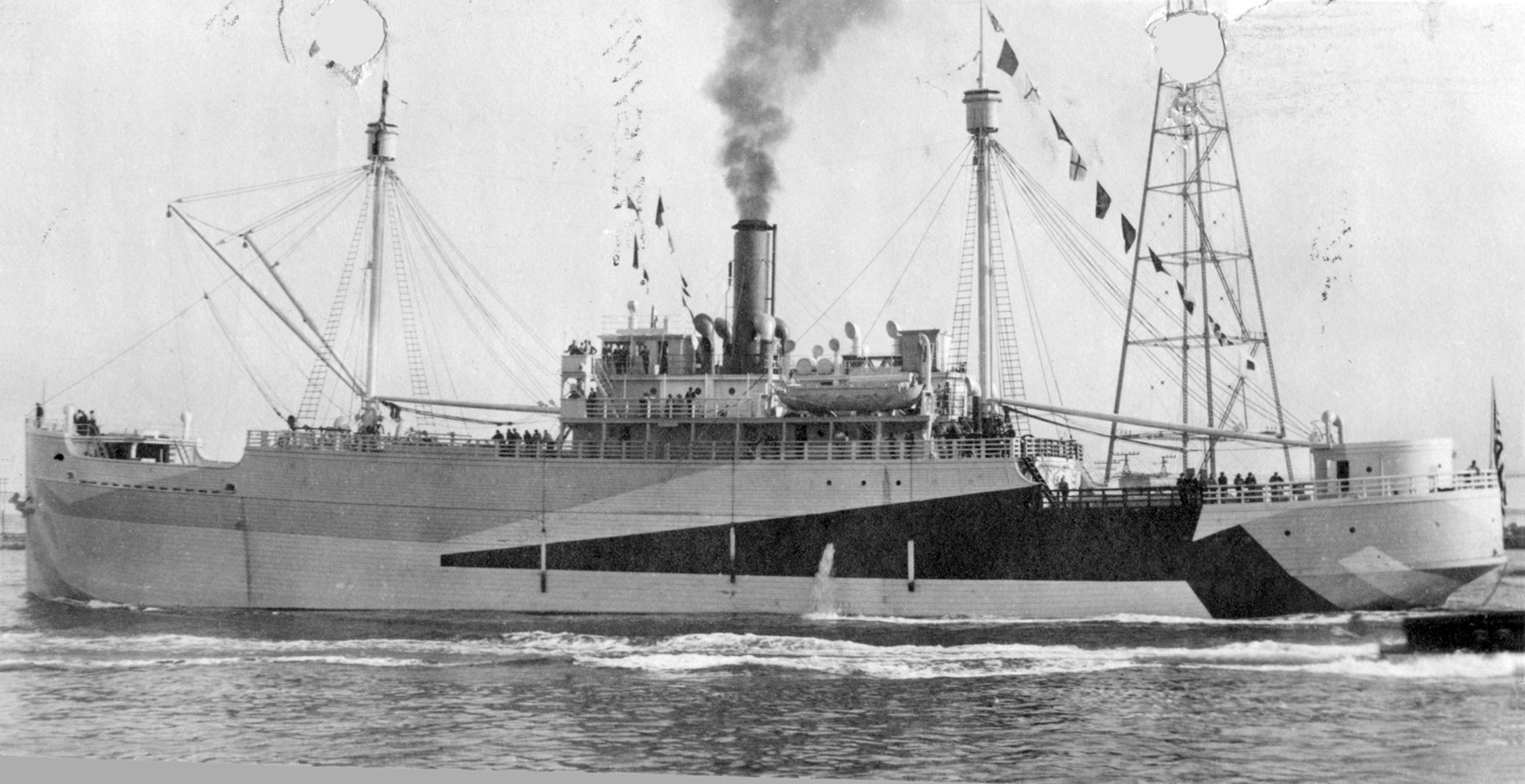
S.S. Coos Bay (Design 1003, Hull 451) The first of the four Hough ships built by the Coos Bay Shipbuilding Co. of Marshfield, Ore., was delivered on 27 August 1918. She was lost on 11 September 1918 on her first voyage when she was pounded by a hurricane and her seams opened. Photo No. None Source: U.S. Naval History and Heritage Command, Ship Histories Branch, SP/ID card. |
 |
|
S.S. Kickapoo (Design 1003, Hull 428) The third of the six Hough ships built by Kruse & Banks Shipbuilding Co. of North Bend (Coos Bay), Ore., was delivered to the EFC on 24 May 1918 and to her managing company for operation on 30 July 1918. She was towed back to port two days after departing San Francisco for Honolulu on 4 August 1918, her captain reporting that she "could not maintain a course within 45 degrees of the course for Honolulu." After trials which confirmed her erratic behavior she was fitted with small sails to assist in steering. Additional steel was later riveted to her rudder to increase its area, while a variety of modifications including wooden rudders were applied to other ships. Photo No. None Source: U.S. Naval History and Heritage Command, Ship Histories Branch, SP/ID card. |
 |
|
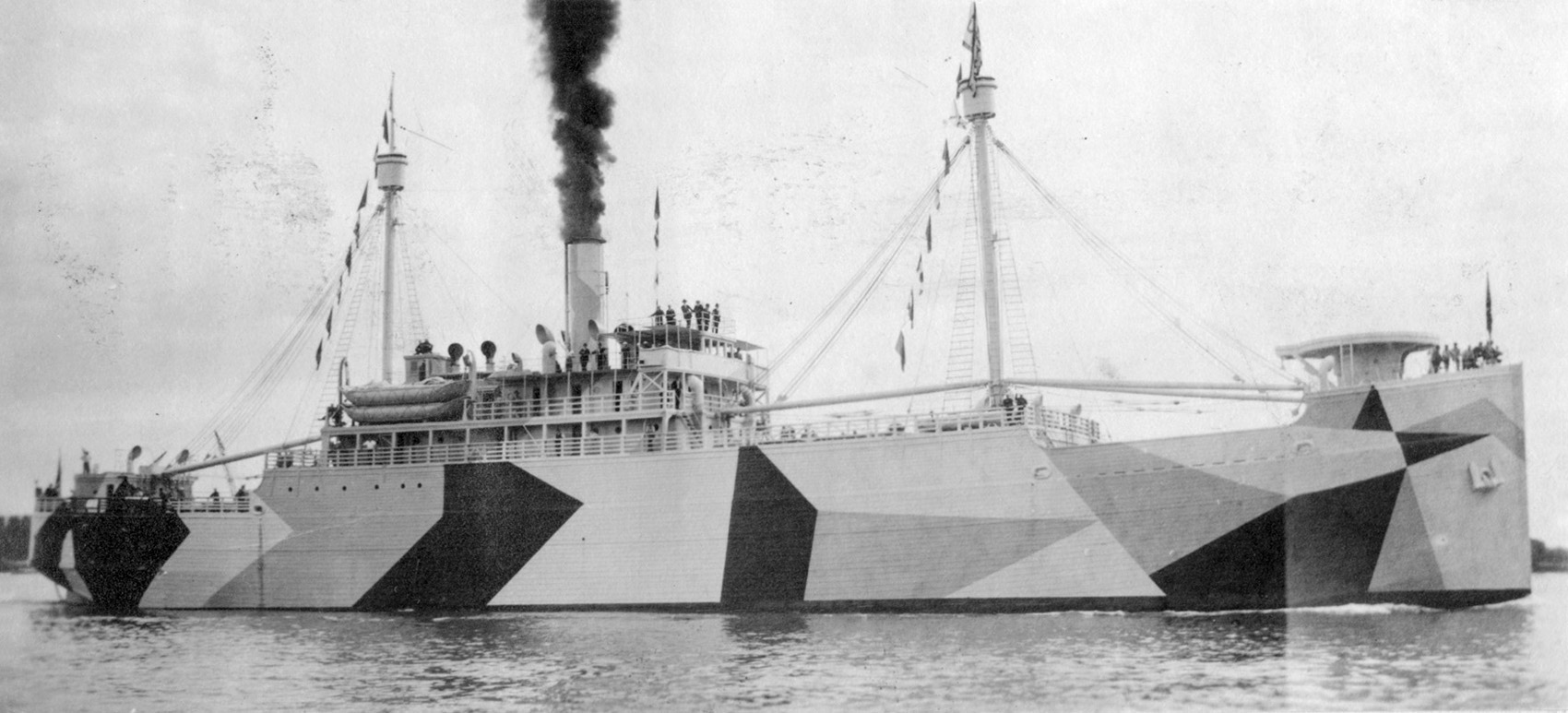
S.S. Catawba (Design 1003, Hull 434) The third of the four Hough ships built by the Fulton Shipbuilding Co. of Wilmington, Calif., was delivered to both the EFC and her managing company on 3 August 1918. In November 1918 she was drydocked to have her steel box rudder enlarged and reconfigured. Photo No. None Source: U.S. Naval History and Heritage Command, Ship Histories Branch, SP/ID card. |
 |
|
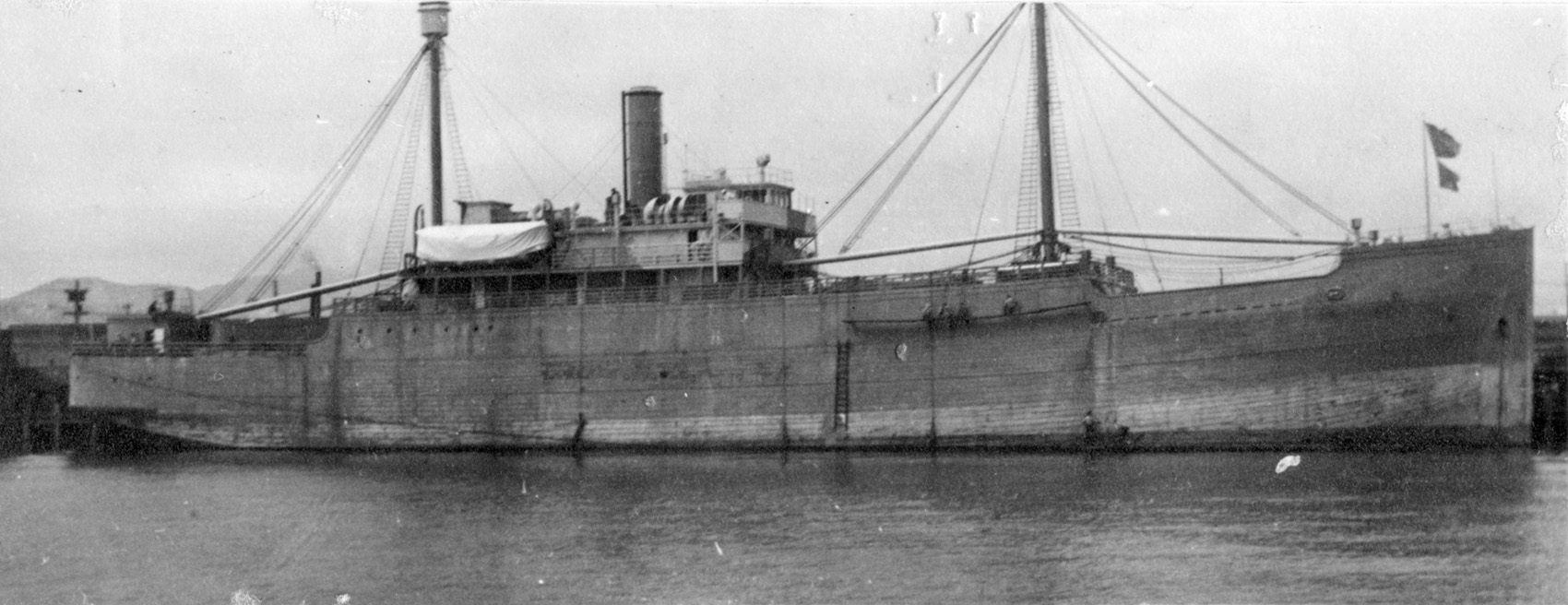
S.S. Coconino (Design 1003, Hull 430) The fifth of the six Hough ships built by the Kruse & Banks Shipbuilding Co. of North Bend (Coos Bay), Ore., was delivered on 25 September 1918 to the Matson Navigation Co. for operation. She burst her seams on her first voyage for Matson with coal in early October and had to return to San Francisco for hull strengthening. Photo No. None Source: U.S. Naval History and Heritage Command, Ship Histories Branch, SP/ID card. |
 |
|
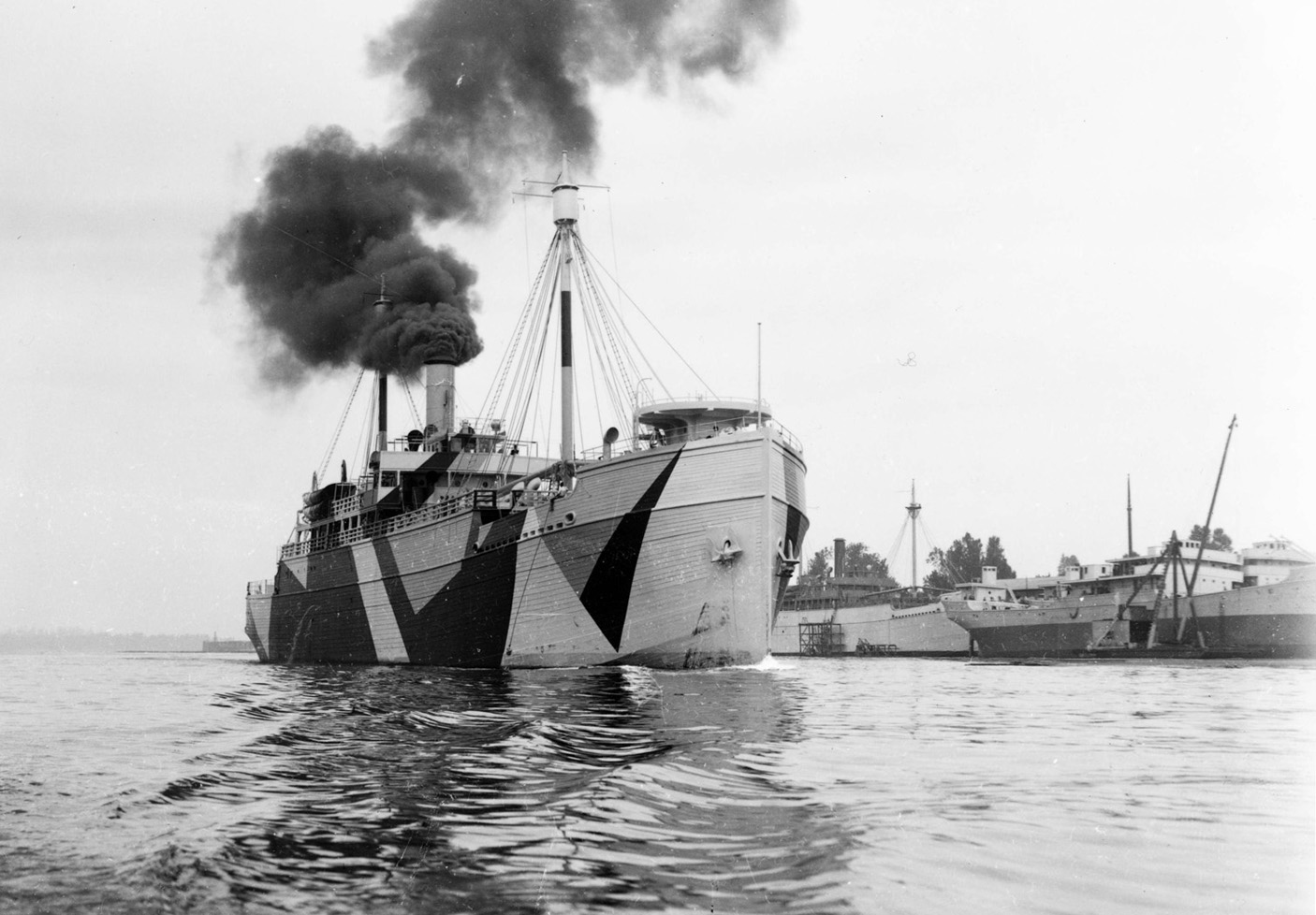
S.S. Kuwa (Design 1003, Hull 260) The Kiser Photo Co. of Portland, Ore., the official photographer for the EFC Oregon District, identified this ship as "Rinia" and gave the date of the image as 21 September 1918. This was the delivery date for Kuwa, the eleventh Hough ship built by the Grant Smith-Porter Ship Co. of St. Johns (Portland), Ore., which is probably the ship shown. Kuwa departed Portland on her maiden voyage on 25 September 1918, picked up a cargo of nitrates at Pisagua, Chile, and delivered it to New Orleans. Photo No. bb000294 Source: Oregon Historical Society Library, Kiser Photo Co. Collection. |
 |
|
S.S. Cotteral (Design 1003, Hull 663) A stern view of the fifth of the ten Hough ships built by the McEachern Ship Co. of Astoria, Ore., on 31 January 1919. She was delivered to the EFC on 13 March 1919 and to Charles T. Magee & Co. for operation on 10 May 1919. She departed Oregon on 18 May 1919 with a cargo of railroad ties for Philadelphia. Photo No. None Source: U.S. National Archives, RG-165-EO Album 2-C |
 |