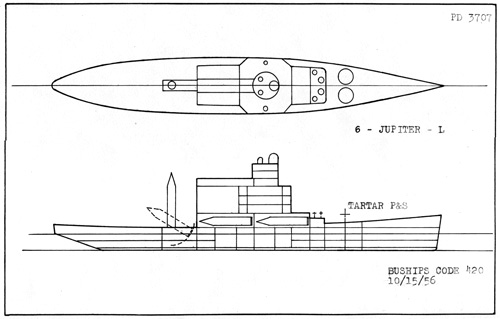
A preliminary design of a new-construction auxiliary with six liquid-fueled Jupiter missiles that briefly replaced EAG 155 in November 1956.
Click on this photograph for links to larger images of this class.
Class: Unnamed (EAG 155, C4-S-1a)
Design: MA C4-S-1a
Displacement (tons): 16,076 full
Dimensions (feet): 563.7' oa, 528' pp x 76' max x 29' load
Armament: --
Accommodations: --
Speed (kts.): 20
Propulsion (HP): 17,500
Machinery: Geared steam turbines, 2 boilers (600psi/875deg), 1 screw
Construction:
| EAG | Name | Acq | Builder | Keel | Launch | Comm |
| 155 | ex PRAIRIE MARINER | -- | -- | -- | -- | -- |
Disposition:
| EAG | Name | T | Decom | Strike | Disposal | Fate | MA Sale |
| 155 | ex PRAIRIE MARINER | -- | -- | 13 Nov 1956 | Canc | -- |
Class Notes:
On 8 November 1955, after much inter- and intra-service wrangling, the Secretary of Defense established "a joint Army-Navy IRBM program having the dual objective of achieving an early shipboard ballistic missile capability and providing an alternative to the Air Force IRBM program." The Army-Navy missile was the Army's Jupiter and the Air Force's missile was the Thor, both liquid-fueled. CNO Admiral Arleigh Burke, a strong supporter of the ballistic missile effort, set up a Special Projects Office under Admiral William F. Raborn to manage the program. On 16 February 1956 Burke formally authorized the conversion of three MARAD Mariner-class (C4-S-1a) cargo ships to support the naval Jupiter IRBM program and directed that they be classified as YAG (Miscellaneous Auxiliary). The ships, which had been referred to Mariner No. 1, No. 2, and No. 3, were tentatively designated YAG 56, 57, and 58 by BUSHIPS pending formal action by SECNAV. On 19 and 30 April 1956 SECNAV and CNO advised four Congressional committee chairs of the Navy's plans to acquire two Mariner cargo ships (which became EAG 153-154) to support development of the FBM, and added that funds for these changes in the program and for advance planning and procurement of material and components for one other Mariner (which became EAG 155), also in furtherance of the Navy's missiles program, to be acquired and converted as part of the Navy's FY 1958 program, were included in a recent request by the President for an increase in appropriations over the original FY 1957 budget estimates. On 22 May 1956 CNO modified his letter of 16 February to specify that the ships were to be classified as AG (miscellaneous auxiliary) using the prefix "E" to indicate their experimental nature, and BUSHIPS tentatively designated them EAG 153, 154, and 155. The first two became COMPASS ISLAND (EAG 153) and OBSERVATION ISLAND (EAG 154), q.v. On 14 June 1956 BUSHIPS notified NSY Norfolk that, in addition to design work for EAG 154 under FY 1957, the preparation of plans and planning work for the conversion of a Mariner ship to EAG 155 under the FY 1958 program was assigned to it, although the assignment of the conversion work would be made at a later date. On 3 July 1956 an internal BUSHIPS memorandum stated that the Mariners to be converted to EAG 154 and 155 were EMPIRE STATE MARINER (MA hull 28, at Mobile) and PRAIRIE MARINER (MA hull 29, in the James River Reserve Fleet). Once FY 1958 funds became available, the conversion schedule called for starting EAG 155 on 1 April 1958 with completion on 30 March 1959.
As of 18 July 1956 the surface FBM (Jupiter IRBM) program consisted of four ships: EAG 153 (navigation systems, to be ready for sea on 2 January 1957), EAG 154 (two FBM launchers, to start contract design in June 1956 and be ready for sea on 30 March 1958), EAG 155 (six FBM launchers, to start contract design in February 1957 and be ready for sea on 30 April 1959), and BBG 1 (ex BB 66, KENTUCKY, with sixteen FBM, to start contract design in mid-1956 and be ready for sea on 15 January 1961). With its six JUPITER launchers, EAG 155 was to be the first surface ship with more than two FBM launchers, and she was later described as the first tactical FBM ship.
On 17 August 1956 BUSHIPS forwarded to the Chairman of the Standing Committee, Long Range Shipbuilding and Conversion Plan, preliminary cost estimates for construction and conversion of Fleet Ballistic Missile Ships. These included conversions of BB 61 and BB 66 class battleships (6 variants), an Essex class carrier, an Alaska class CB, a Baltimore class CA, a new construction warship, and a new construction auxiliary (but no converted auxililary). A design study for the new construction auxiliary was then underway, and its characteristics were 450' pp x 60', 7,500 tons displacement (5,000 tons light), 35,000 SHP, 25 knots sustained speed, and an armament of two IRBM launchers (6 missiles) aft of the superstructure and two twin TARTAR launchers or one twin TERRIER launcher forward. One version used the liquid-fueled Jupiter (above) while the other used the solid-fueled Jupiter-S. (Characteristics on the various preliminary design drawings differ slightly.) On 21 September 1956 Admiral Raborn (Special Projects Office) was particularly interested in the small (6 FBM) ships in contrast to the larger combatant types and the emphasis in design work shifted towards them.
A proposed FY 1958-1962 Shipbuilding and Conversion Plan dated 18 September 1956 added one EAG (the Mariner #3 conversion) to the FY 1958 program at a cost of $62 million (nearly twice the cost of a new AOR). On 1 October 1956 she was described in a presentation to the Shipyard Commanders' Conference on "New Design Trends" by the director of the BUSHIPS Design Division as the first tactical FBM ship, very similar to EAG 154 but carrying six Jupiter missiles on vertical elevator-launchers in the magazine area and a somewhat more refined fire control system than the breadboard model planned for EAG 154. However a Preliminary Design memo for file dated 22 October 1956 reviewing the status of FBM surface ship design studies stated that there was an unofficial consensus as of 18 October 1956 that a new-construction replacement for the Mariner 3 conversion was required that would be competitive in cost with the $100 million budgeted for the conversion. CNO removed the Mariner 3 conversion from the proposed FY 1958 program before forwarding it to SECNAV on 23 October 1956. On 9 November 1956 SECNAV requested that SECDEF authorize a reorientation of the FBM program, and on 13 November 1956 he deleted the Jupiter EAG (EAG 155) from the FY 1959 program (where it had been since at least 25 October 1956) and moved the new-construction FBM surface ship from FY 1960 to FY 1959. The prototype FBM surface combatant ship was to have a full load displacement of about 6,000 tons, making her a development of the "new construction auxiliary." Preliminary designs were drafted for both the liquid Jupiter and solid Jupiter-S. All work on surface ships with the liquid-fueled Jupiter had been discontinued by 21 November 1956. Note that EAG 155 was never part of the Polaris program.
Ship Notes:
| EAG | Name | MA | Notes |
| 155 | ex PRAIRIE MARINER | 29 | FY 1958, then FY 1959. Tentatively designated YAG 56 Feb-May 1956 and then EAG 155 but number never formally assigned. PRAIRIE MARINER (MA hull 29) later became APA 249, q.v. |
Page Notes:
Compiled: 18 Oct 2021
© Stephen S. Roberts, 2021
Special sources: NARA: RG 19 Entry UD 1024-AD Box 1.